
If you’re planning your first trip on Japan’s famous Shinkansen, you might be surprised to learn that there isn’t just one bullet train. On the Tokaido Shinkansen—the line connecting Tokyo, Kyoto, and Osaka—you’ll see three names:
- Nozomi
- Hikari
- Kodama
They look the same from the outside, but they’re not the same.
Each train has different speeds, stop patterns, travel times, prices, and JR Pass rules, which can be confusing if you’re new to Japan’s railway system.
This beginner-friendly guide breaks everything down in a simple, clear way.
Why Are There Three Types of Shinkansen?
Japan’s Tokaido Shinkansen is one of the busiest high-speed rail lines in the world.
To keep trains running smoothly—and to offer options for different types of travelers—JR operates three service patterns on the same tracks:
- Nozomi (fastest, few stops)
- Hikari (fast but stops at more cities)
- Kodama (slowest, stops at every station)
All three use the same train models (such as the N700 and N700S), so the ride quality and comfort are nearly identical.
What really makes them different is how many stops they make and how quickly they travel between major cities.
Quick Comparison Chart (Speed, Stops, JR Pass Rules)
Here’s a simple side-by-side comparison of Nozomi, Hikari, and Kodama—the three services on the Tokaido Shinkansen line.
| Feature | Nozomi | Hikari | Kodama |
|---|---|---|---|
| Speed / Travel Time | 🚄 Fastest (Tokyo → Shin-Osaka: ~2 hr 25–30 min) | ⚡ Fast (~3 hr) | 🐢 Slowest (~4 hr) |
| Number of Stops | Fewest stops (only major cities) | Moderate (major + mid-size cities) | Stops at every station |
| JR Pass | ❌ Not covered (requires extra special ticket) | ✅ Fully covered | ✅ Fully covered |
| Price | Highest | Same as Kodama | Same as Hikari |
| Best For | Travelers who want the fastest route | JR Pass users / general travelers | Short-distance riders / slow-travel / budget flexibility |
| Common Use Cases | Business travel, tight schedules | Balanced choice for most tourists | Local travel, reaching smaller towns |
Travel Time: Tokyo ↔ Kyoto / Shin-Osaka
Below is a simple, side-by-side comparison of travel times from Tokyo to Kyoto and Tokyo to Shin-Osaka. All three Shinkansen types follow the same route, but the number of stops changes the total travel time.
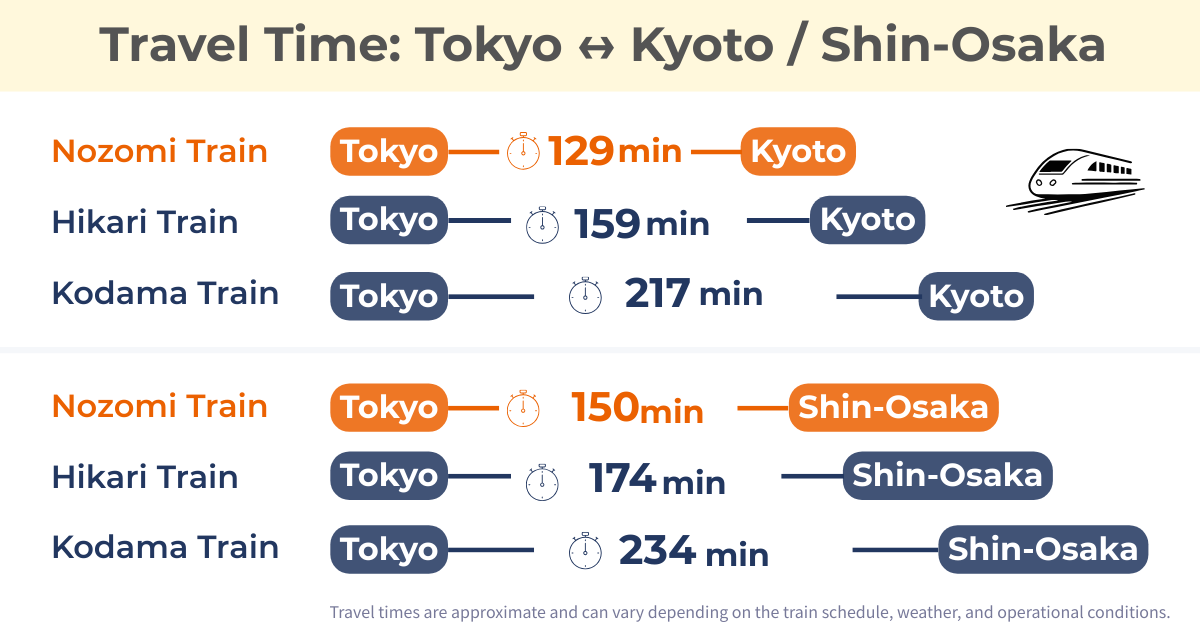
- Nozomi is the fastest, stopping at only a few major stations.
- Hikari offers a balance of speed and convenience, making it the best option for JR Pass users.
- Kodama stops at every station, so it takes the longest but is useful for travelers heading to smaller cities along the Tokaido line.
Which One Should You Choose? (Short Answer)
- If you want the fastest trip: Nozomi
- If you’re using a JR Pass: Hikari (Nozomi is not included)
- If you’re visiting smaller towns along the way: Kodama
- If you simply want the easiest choice: Hikari is a safe, comfortable middle option
Where Do They Stop? (Nozomi vs Hikari vs Kodama)
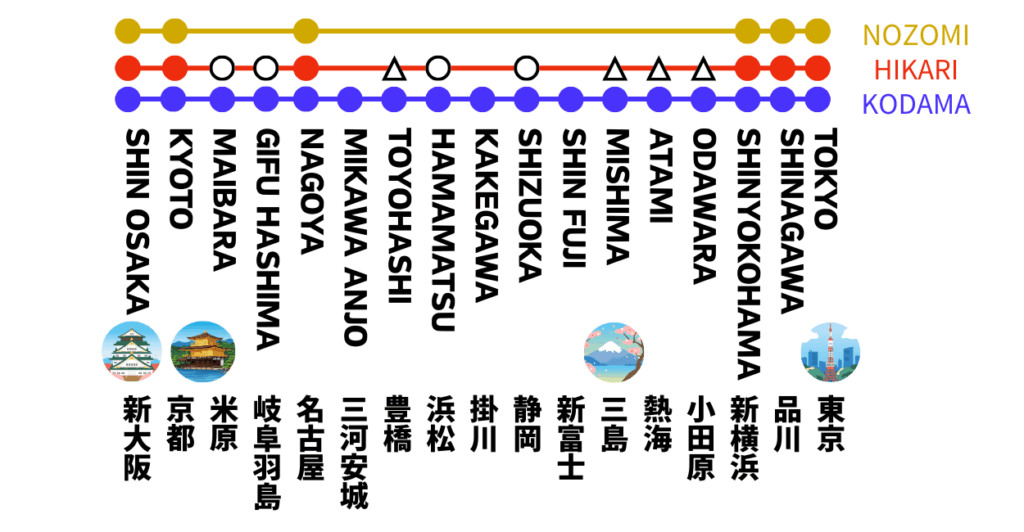
- Nozomi (orange line) stops only at major cities such as Tokyo, Nagoya, Kyoto, and Shin-Osaka.
- Hikari (red line) stops at some, but not all, stations. It’s faster than Kodama but slower than Nozomi because the stopping pattern varies by train and time of day.
- Kodama (blue line) stops at every station along the Tokaido line, making it the slowest but the most convenient for reaching smaller cities.
If you’re planning to travel beyond the big cities—such as Odawara, Shizuoka, Hamamatsu, or Mikawa-Anjo—Kodama will always stop, while Hikari may or may not, depending on the train.
For JR Pass users, Hikari is usually the fastest option, but it’s a good idea to check the timetable if you need a specific station.
Which One Should You Choose?
Choosing between Nozomi, Hikari, and Kodama is easier once you know the basic differences. All three trains are clean, safe, and extremely comfortable—but they serve slightly different travel needs.
- Fastest? → Nozomi
- JR Pass? → Hikari
- Stopping at small towns? → Kodama
For most travelers—especially first-timers—Hikari is the most reliable and beginner-friendly choice.
But no matter which one you ride, the Shinkansen is one of the easiest and most comfortable ways to travel in Japan. Just sit back, enjoy the smooth ride, and don’t forget to look out the window for Mount Fuji on a clear day.