
If you’re reading this, you probably already know that Japan’s Shinkansen has a “Green Car” — the premium seat option.
But this is where many travelers stop and wonder:
“Is it really worth paying extra?”
“How much more comfortable is it, actually?”
“And what about my large suitcase… where am I supposed to put it?”
In this guide, we’ll walk through:
- The real differences between the Green Car and the Ordinary Car
- Whether the upgrade is truly worth the price
- How luggage space compares and where you can store large suitcases
- And who the Green Car is best suited for
Green Car vs. Ordinary Car: What’s the Real Difference?
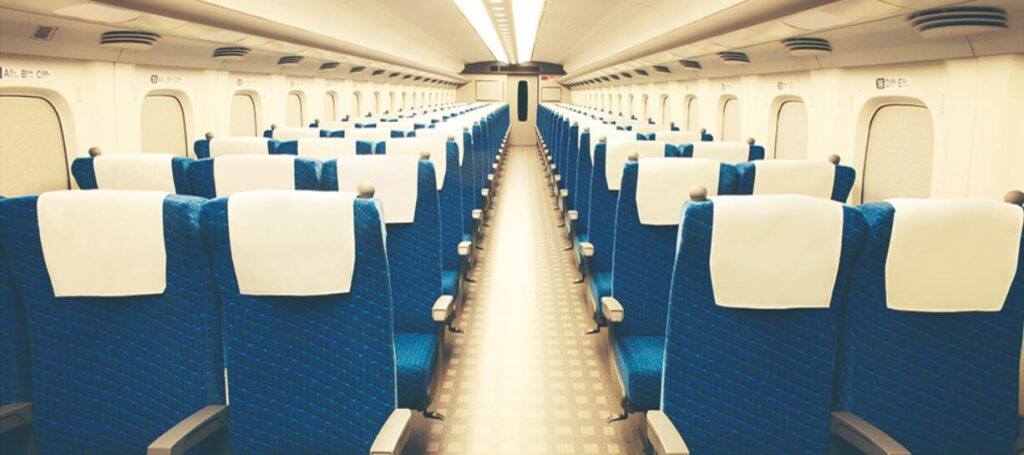
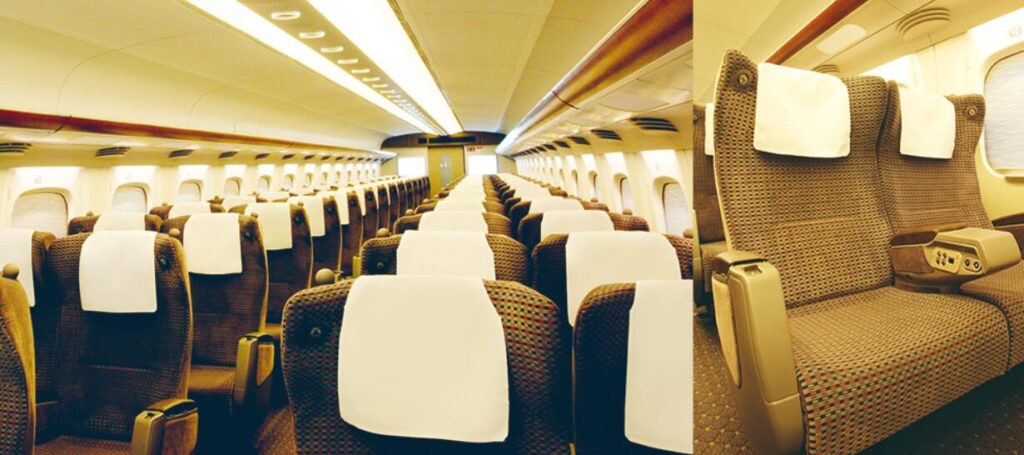
Before choosing your seat, let’s break down the key differences travelers care about the most:
🟩 Green Car (Premium Class)
- More spacious seats with wider armrests
- Extra legroom and deeper recline
- Quieter, less crowded environment
- Warm towels (on some lines)
- Typically used by business travelers or comfort-focused visitors
🟦 Ordinary Car (Standard Class)
- Standard seating with less width
- Can get crowded during peak times
- More budget-friendly
- Absolutely comfortable enough for short to medium trips
| Feature | Green Car | Ordinary Car |
|---|---|---|
| Seat Width | ★★★★★ Wide & comfortable | ★★★☆☆ Standard |
| Legroom | ★★★★★ Very spacious | ★★★★☆ Good |
| Quietness | ★★★★★ Very quiet | ★★★☆☆ Noisy at times |
| Price | $$$ | $$ |
| Best For | Long trips, comfort seekers, big luggage | Budget travelers, short distances |
Is the Green Car Worth the Extra Cost?
The short answer: It depends on your travel style.
Here’s who will truly appreciate the upgrade:
🟩 You should consider Green Car if…
- You want a quiet, relaxed ride
- You’re taking a longer route (e.g., Tokyo → Osaka → Hiroshima)
- You prefer wider seats & extra legroom
- You want guaranteed access to power outlets for charging your phone or laptop
🟦 Ordinary Car is perfectly fine if…
- Your trip is short (Tokyo → Shin-Osaka)
- You don’t mind sitting near other travelers
- You’re staying on a budget
Luggage Space: Green Car ≠ Bigger Storage
Many travelers assume that the Green Car comes with more luggage space —
but this is not true.
Whether you choose the Green Car or the Ordinary Car,
large suitcases follow the same rules, and both cars require a reservation for oversized baggage seats when your luggage is big.
🟩 Green Car Luggage Options
Green Car has overhead shelves, but:
- they are for small or medium luggage only
- large suitcases do NOT fit
- footrests make it harder to place luggage at your feet
Where is Green Cars located?
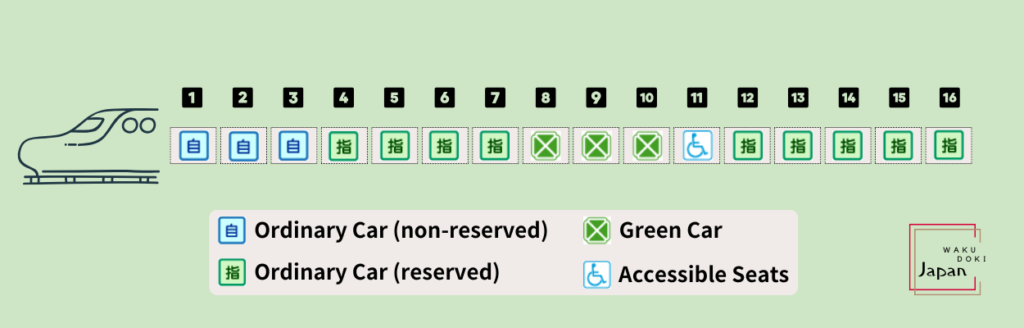
Green Cars on the Shinkansen are typically located in the middle or front section of the train, depending on the train model and route. Their placement is strategic for convenience and accessibility, often near key facilities such as restrooms or multi-purpose rooms.
Here’s a typical train configuration: Green Cars are located in the 8th, 9th, and 10th cars on this model.
Green Car Price: How Much More Does It Cost?
The price difference between the Green Car and the Ordinary Car depends on whether you’re using a JR Pass or buying single tickets.
Because these two systems work completely differently, it’s easiest to compare them separately.
JR Pass — Green Car vs Ordinary Car Price
If you plan to use a JR Pass during your trip, here’s the most important point:
The standard JR Pass does NOT include Green Car seats.
To ride the Green Car, you must purchase the Green Car JR Pass from the beginning.
Prices vary by duration, but here’s the general idea
JR Pass Prices
(“Child” refers to children who are 6 to 11 years old at the time when the JR Pass is used.
*Prices are subject to change. Here are the prices as of November 2025. )
approx. $448
approx. $704
approx. $896
approx. $320
approx. $512
approx. $640
→ The Green Car JR Pass costs significantly more, so it’s only worth it if:
- you prefer comfort for multiple long rides
- you plan to take several Shinkansen trips
- you want quiet, spacious seating for your entire journey
→ When the Green Car JR Pass is NOT worth it
- If you mostly take short trips (Tokyo → Osaka only)
- If you’re on a tight budget
- If you will use local trains more than Shinkansen
Single Tickets — Green Car vs Ordinary Ticket Prices
If you’re buying individual tickets instead of a JR Pass, the price difference becomes much smaller—and often surprisingly reasonable.
Here are the common routes:
| Route | Ordinary Car | Green Car | Difference |
|---|---|---|---|
| Tokyo → Shin-Osaka | ~¥14,920 | ~¥19,790 | ~¥5,000 (~$32 USD) |
| Tokyo → Kyoto | ~¥14,370 | ~¥19,240 | ~¥5,000 (~$32 USD) |
| Tokyo → Hiroshima | ~¥19,960 | ~¥27,220 | ~¥7,000 (~$45 USD) |
What this means for travelers:
- The upgrade fee for a single trip is much lower than buying the Green Car JR Pass.
- If you’re only taking one or two Shinkansen rides, a single-ticket upgrade to the Green Car can be a great value.
- The Green Car experience you get is the same, regardless of whether you use a JR Pass or buy a single ticket.
Conclusion
Ultimately, both the Green Car and the Ordinary Car offer an excellent Shinkansen experience. Japan’s bullet trains are clean, fast, and comfortable no matter which seat you choose.
But if you want a quieter ride, more space, and a smoother experience for long-distance travel, the Green Car upgrade can make your journey noticeably more relaxing. Just remember:
it does not provide extra luggage space, and large suitcases still require an Oversized Baggage Area seat—whether you ride in the Green Car or not.
For travelers on a budget, the Ordinary Car remains a perfectly comfortable option, especially for shorter routes.
Whichever option you choose, the Shinkansen is one of the best ways to experience Japan—reliable, comfortable, and surprisingly stress-free. Enjoy the journey!
Klook.com