
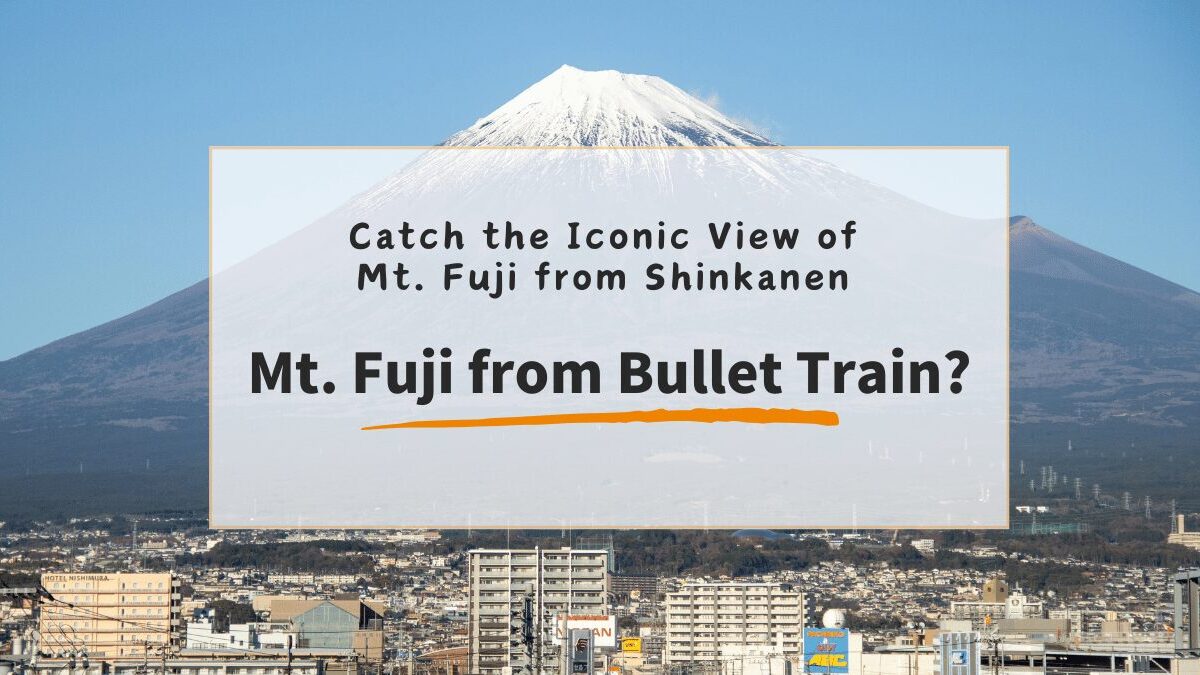
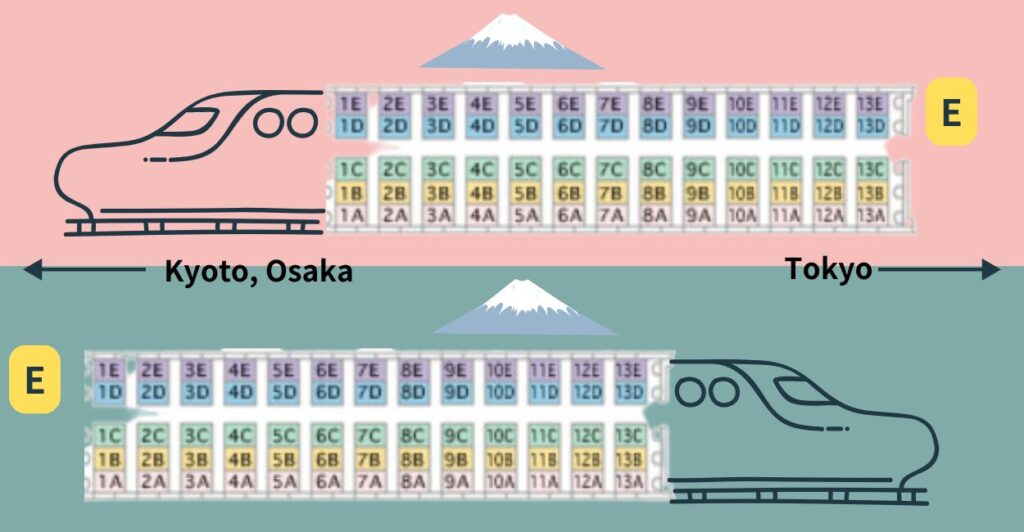
Heading to Osaka — or back to Tokyo? Either way, Mt. Fuji is always on the E seat side.
Right side going to Osaka. Left side heading back to Tokyo. The seat letter never changes.
| Direction | Mt. Fuji Side | Seat to Book |
|---|---|---|
| Tokyo → Osaka / Kyoto | Right side 🗻 | Seat E |
| Osaka / Kyoto → Tokyo | Left side 🗻 | Seat E |
| Green Car (either direction) | Same rule | Seat D |
👉 Book Seat E on SmartEX — Select directly from the seat map (English available)
👉 Book via Klook — Request Mt. Fuji view side
⚠️ Many travel blogs say “Seat A on the return trip” — but that’s incorrect. The E seat stays on the Mt. Fuji side in both directions, because Shinkansen trains don’t turn around.
This guide covers exactly when Mt. Fuji comes into view, how to time it by train type (Nozomi, Hikari, or Kodama), and what to do if it’s cloudy.
When and Where to See Mt. Fuji from the Shinkansen
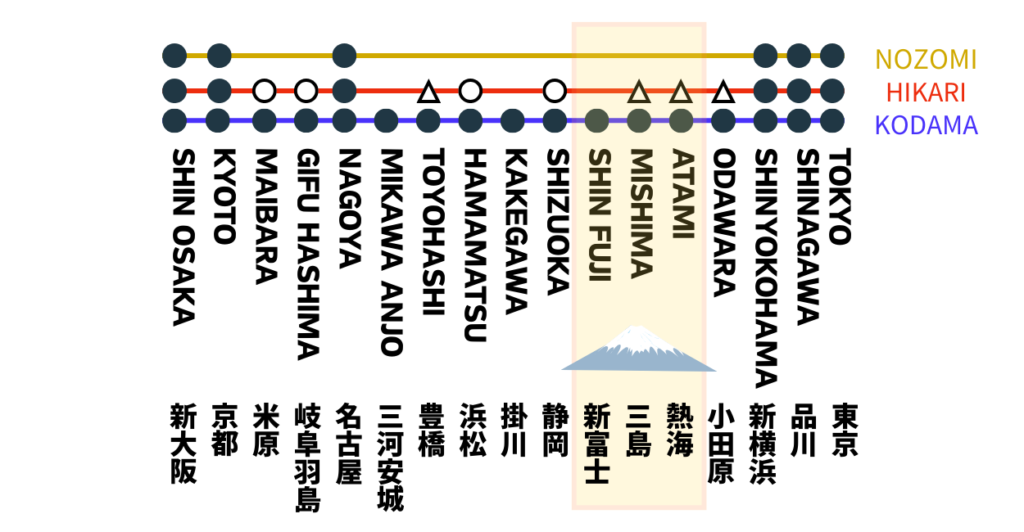
Mt. Fuji is visible between Atami Station and Shin-Fuji Station — the stretch where the train passes closest to the mountain. On a clear day, you get around 30–60 seconds of an unobstructed view.
Traveling from TOKYO to OSAKA
Mt. Fuji appears on the right-hand side of the train.
- Nozomi — About 40–45 minutes after leaving Tokyo Station. The train runs non-stop after Shin-Yokohama, so watch your time from there.
- Hikari — Also around 40–45 minutes after Tokyo. Some Hikari trains stop at Atami, so timing may vary slightly.
- Kodama — Look out the window shortly after departing Atami Station, approximately 50 minutes from Tokyo.
💡 Tip: Start watching as soon as you pass Atami Station. Mt. Fuji can appear suddenly, and at Shinkansen speed, it disappears just as fast.
Traveling from OSAKA to TOKYO
Mt. Fuji appears on the left-hand side of the train.
- Nozomi — About 70–80 minutes after departing Shin-Osaka Station. After Nagoya, there are no stops until the viewing zone — check your watch from Nagoya.
- Hikari — Around 70–80 minutes after Shin-Osaka. Some services stop at Shizuoka, so timing may shift slightly.
- Kodama — Look between Shizuoka and Shin-Fuji Stations, around 85–90 minutes after Shin-Osaka.
If you are using a JR Pass, note that Nozomi trains are not covered. You can reserve seats on Hikari or Kodama — and since Hikari stops at Shin-Fuji, it can actually give you a slightly longer viewing window.
Best Time to See Mt. Fuji from the Shinkansen
Best Season
| Season | Visibility | Why |
|---|---|---|
| Winter (Dec – Feb) | ⭐⭐⭐⭐⭐ Best | Crisp, dry air. Snow-capped peak stands out clearly. |
| Autumn (Sep – Nov) | ⭐⭐⭐⭐ Very good | Clear skies return after summer. Early snow from October. |
| Spring (Mar – May) | ⭐⭐⭐ Fair | Warmer air brings more haze. Still possible on clear mornings. |
| Summer (Jun – Aug) | ⭐ Difficult | Rainy season and heat haze make views rare. |
Best Time of Day
Morning trains give you the best chance. Haze builds up as the day goes on, especially in spring and summer. If you have flexibility, booking an early departure — before 10am — improves your odds noticeably.
Mt. Fuji is not lit at night, so even from the correct seat, it is usually impossible to see after dark.
Even with the perfect seat, perfect season, and perfect timing — a clear view is never guaranteed. Clouds and haze can hide the mountain completely. If Mt. Fuji doesn’t appear, don’t be disappointed: think of it as a reason to ride the Shinkansen again.
🎫 Traveling between Tokyo, Kyoto, and Osaka?
A JR Pass may be worth considering — seat reservations are free and unlimited.
How to Book Seat E for the Mt. Fuji View
When to Book
Seat reservations open exactly 30 days before departure at 10:00 a.m. Japan time. During peak seasons (Golden Week, Obon, New Year), book the moment reservations open — Fuji-side window seats go fast.
Option 1: SmartEX — Best for Overseas Visitors (Single or Return Tickets)
SmartEX is the official JR Central booking site and the most reliable option for buying individual Shinkansen tickets from overseas. It has a full English interface, lets you select your seat directly from a seat map, and issues a QR ticket to your phone.
⚠️ Credit card note: SmartEX accepts Visa, Mastercard, Amex, JCB, Diners, and Discover issued overseas — but some cards are rejected due to Japan’s 3D Secure authentication. If your card is declined, don’t worry: the same card usually works fine at a ticket machine inside Japan. See Plan B below.
Option 2: Klook (Mt. Fuji View Preference)
Klook offers a straightforward English booking experience. When booking a Tokyo–Osaka route, you can request the Mt. Fuji view side as a preference — however, Seat E is not guaranteed, as seat assignment depends on availability.
Option 3: JR Pass Holders
Seat reservations with a JR Pass are free and unlimited. How you reserve depends on where you purchased your pass:
- Purchased on the official JAPAN RAIL PASS Reservation website — You can reserve Seat E online from anywhere in the world before you leave home. Reservations open 30 days before departure at 10:00 a.m. Japan time. Don’t forget to pick up your physical seat ticket at a station machine before boarding.
- Purchased through Klook or another agent — Online reservation is not available. After exchanging your voucher for the physical pass in Japan, visit any JR Ticket Office (Midori no Madoguchi) or reserved seat ticket machine at a major station and show: 「E席をお願いします」(E-seki wo onegaishimasu). Reservations are free.
⚠️ JR Pass holders cannot ride Nozomi — book Hikari or Kodama instead. Hikari stops at Shin-Fuji Station, making it a great choice for the Mt. Fuji view.
Plan B: Buy at the Station After Arriving in Japan
If online booking doesn’t work, buying tickets at the station is easy and reliable. Multilingual ticket machines at major stations (Tokyo, Kyoto, Shin-Osaka) accept most foreign credit cards with no 3D Secure step — the same card that failed online will often go through without any issue.
Already Have a Ticket? How to Change Your Seat
If your current seat isn’t Seat E, you can change it at any JR Ticket Office or ticket vending machine before your train departs. Changes must be made before your original departure time — once the train leaves, changes are no longer possible.
Frequently Asked Questions
- QWhich side of the Shinkansen should I sit on from Osaka to Tokyo?
- A
From Osaka (or Kyoto) to Tokyo, Mt. Fuji is on the left side of the train. Book Seat E — the same seat as the Tokyo-to-Osaka direction. The seat letter never changes, because Shinkansen trains do not turn around.
- QDoes it matter whether I take the Nozomi, Hikari, or Kodama?
- A
All three services pass the Mt. Fuji viewing zone, so Seat E works on all of them. That said, Hikari stops at Shin-Fuji Station, which can give you a slightly longer window to enjoy the view. Nozomi is the fastest but skips Shin-Fuji. JR Pass holders cannot ride Nozomi — Hikari is actually the better choice for the view anyway.
- QCan I see Mt. Fuji at night?
- A
Generally no. Mt. Fuji is not lit at night, so even from Seat E, the mountain is usually too dark to see after sunset. If seeing Mt. Fuji is a priority, choose a daytime train.
- QWhat if Mt. Fuji is hidden by clouds?
- A
It happens — even on days that start clear, clouds can build up quickly around the summit. A few things that help: take a morning train (haze is usually lowest before 10 a.m.), travel in winter or autumn for the clearest skies, and check the weather forecast for the Shizuoka area before you board. If the mountain doesn’t appear, it simply means you have a good reason to ride the Shinkansen again.
- QIs Seat E guaranteed when booking through Klook?
- A
No. On Klook, the Mt. Fuji view side is listed as a preference, not a guaranteed seat assignment. For a guaranteed Seat E, use SmartEX, where you select directly from a seat map. If you have a JR Pass, seat reservations are free — but note that the JAPAN RAIL PASS Reservation online system is only available if you purchased your pass through that official site. Passes bought via Klook or other agents require reservations to be made in person at a JR Ticket Office or station machine after arriving in Japan.
- QCan I see Mt. Fuji from the other side of the train?
- A
Not properly — but a partial glimpse is possible. Mt. Fuji cannot be seen through your own window from Seat A, as it faces the opposite direction (the Pacific Ocean and Izu Peninsula side). However, if the aisle happens to be clear and no one is blocking the view, you may be able to catch a brief, angled glimpse across the car through the E-seat windows. For a proper view, Seat E is the one to book.
Ready to see Mt. Fuji from the Shinkansen?
Book Seat E before it sells out — especially if you’re traveling in peak season.